12 Best Things to Do in Sokcho, South Korea (2026 Guide)
Sokcho (속초) sits on South Korea's east coast in Gangwon Province, wedged between the East Sea and the towering granite peaks of Seoraksan National Park (설악산국립공원). Most visitors come for the hiking, but the city also serves excellent seafood, maintains a distinctive North Korean refugee heritage, and offers quiet beaches far less crowded than Busan. This guide covers the core attractions, realistic costs, practical transport between trailheads and town, and the decisions that shape whether you stay one night or four.

- Distance from Seoul
- Roughly 210 km; about 2.5 hours by express bus from Seoul Express Bus Terminal (roughly 18,000-24,000 KRW one-way; check timetables at txbus.t-money.co.kr or bustago.or.kr).
- Best time to visit
- Late September to early November for autumn colours in Seoraksan; late spring (May-June) for milder hiking weather; avoid Korean public holidays when trails and cable cars see multi-hour queues.
- Recommended stay
- Two full days minimum: one for Seoraksan hiking, one for town attractions and seafood. Add a third day if you plan both outer and inner Seorak trails or a beach afternoon.
- Navigation app
- Use Naver Map or KakaoMap in English; Google Maps does not provide walking or driving directions inside South Korea due to mapping-data restrictions. Transit directions on Google work, but coverage in Sokcho is limited.
- Cash vs card
- Cards widely accepted in restaurants and convenience stores; carry cash (20,000-30,000 KRW) for small market stalls and the Abai Village ferry (1,000 KRW per crossing).
- Entry formalities
- Nationals of 22 countries (including the US, Canada, UK, Germany, France, Italy, Netherlands, Spain, Australia, New Zealand and Japan) are exempt from K-ETA for 2026; these travellers must instead submit the e-Arrival Card at e-arrivalcard.go.kr within three days before arrival. Check k-eta.go.kr to confirm your nationality's status.
- Hike the trails in Seoraksan National Park
- Visit Sinheungsa Temple and the Bronze Buddha
- Explore the seafood stalls and vendors at Sokcho markets
- Learn North Korean history at Abai Village
- Relax at Sokcho Beach and the coastal boardwalk
- Take a day trip to Naksansa Temple or Hwajinpo Beach
- Getting to and around Sokcho
- Comparison of Sokcho's main attractions by time, cost and difficulty
- Practical tips
- Frequently asked questions
Hike the trails in Seoraksan National Park
Seoraksan National Park is the reason most travellers come to Sokcho. The park divides into outer Seorak (외설악), accessible directly from Sokcho, and inner Seorak (내설악), reached via a separate entrance near Inje. The outer section offers the most-visited trails and the Gwongeumseong cable car (권금성 케이블카).
The cable car runs to Gwongeumseong Fortress, a short rocky outcrop with wide views over the coast and peaks. Expect queues of one to two hours on weekends and public holidays in autumn; weekday mornings in late September or October see shorter waits. The return fare typically runs 12,000-15,000 KRW; confirm current prices and operating hours at seoraksan.knps.or.kr before you go, as the service closes in high winds.
For serious hikers, the Ulsanbawi Rock (울산바위) trail climbs roughly 800 stone and metal steps to a granite outcrop that towers over the park. The round trip takes three to four hours at a steady pace. Start early: the first shuttle buses from Sokcho to the park entrance run around 6:00-6:30 a.m., and finishing before midday avoids the peak-hour crowds descending.
Other popular routes include Biseondae (비선대), a river-gorge walk that takes about two hours return, and Heundeulbawi (흔들바위), a short trail to a rocking boulder near Sinheungsa Temple. National park entry typically costs 3,500-4,000 KRW per adult; seniors and children pay reduced rates. Payment is cash or card at the entry gate. The park operates year-round, but snow closes some high trails from December to March.
Wear proper hiking boots; the trails are rocky, and the metal staircases on Ulsanbawi become slippery in rain. Convenience stores near the park gate sell water, kimbap (김밥) and snacks; prices are slightly higher than in town but not extreme. Pack out all litter; the park enforces strict waste rules.
Visit Sinheungsa Temple and the Bronze Buddha
Sinheungsa (신흥사) is a working Buddhist temple founded in the seventh century and rebuilt several times after fires. It sits just inside the Seoraksan outer entrance, a ten-minute walk from the ticket gate, and most hikers pass through on the way to Ulsanbawi or the cable car.
The temple's most photographed feature is the massive seated bronze Buddha (통일대불), installed in 1997 and standing roughly 14.6 metres tall. The statue faces the East Sea and symbolises hopes for Korean reunification. You can walk right up to the platform; the temple grounds are open to visitors free of charge, though donations are welcome if you enter the main worship halls.
The complex includes several wooden halls painted in traditional dancheong (단청) patterns, a stone pagoda and a small museum displaying Buddhist artefacts. Visitors are expected to remove shoes before entering worship halls, speak quietly, and refrain from flash photography inside. The temple operates daily, but ceremony times vary; morning visits around 7:00-9:00 a.m. sometimes coincide with chanting services, which non-Buddhists may observe respectfully from the back.
The walk from the park entrance to the temple is paved and flat, suitable for wheelchairs and strollers as far as the main courtyard. Beyond that point, trails turn steep and rocky. If you have limited time or mobility, the temple and Bronze Buddha make a manageable half-hour visit without committing to a full hike.
Combine the temple with a walk along the shallow stream that runs beside it; the water is clear, and in warmer months you'll see families wading. The area is heavily visited in autumn, so arrive before 9:00 a.m. or after 4:00 p.m. to avoid bus-tour crowds.
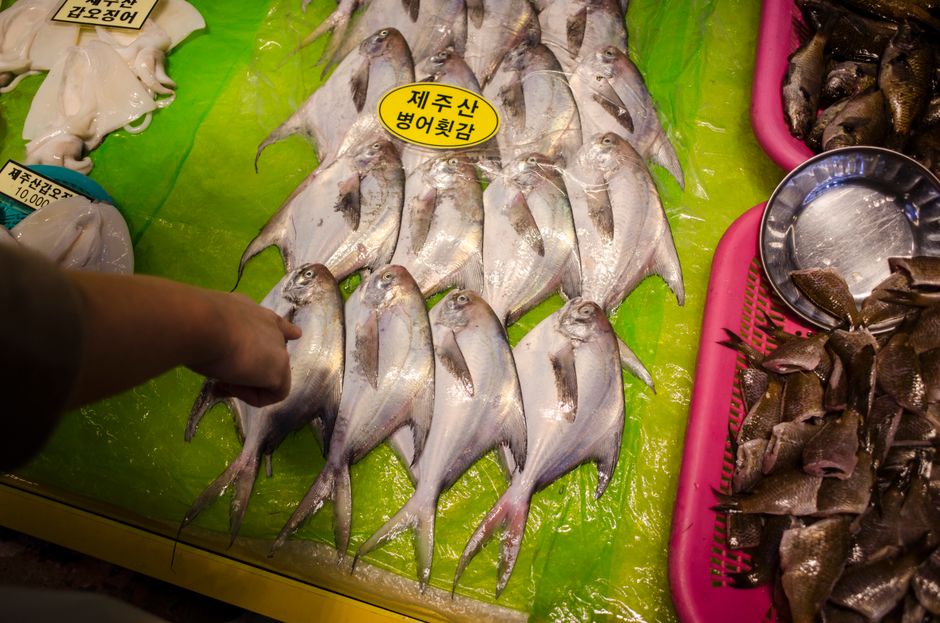
Explore the seafood stalls and vendors at Sokcho markets
Sokcho's fishing heritage translates into some of the freshest and most affordable seafood on South Korea's east coast. Two markets anchor the experience: Sokcho Jungang Market (속초중앙시장) and Daepo Port (대포항).
Sokcho Jungang Market sits in the city centre, a five-minute walk from Sokcho Express Bus Terminal. The covered market sprawls across several alleys selling fresh fish, dried squid, seaweed, vegetables and prepared banchan (반찬, side dishes). The real draw is the grilled-seafood vendors clustered near the market's north side, where you can buy raw fish by weight and have it grilled on the spot for a small cooking fee (typically 3,000-5,000 KRW per table). Expect to pay roughly 20,000-35,000 KRW per person for a filling seafood meal, depending on what you order. Popular choices include grilled mackerel (고등어), squid (오징어) and seasonal shellfish.
Daepo Port, about 3 km south of the city centre, functions as a working fishing harbour with rows of raw-fish restaurants (횟집) offering sliced raw fish (hoe, 회) and spicy seafood stews. Prices are similar to Jungang Market but portions tend to be larger, and the setting—overlooking moored boats—adds atmosphere. The port is also known for stuffed squid (오징어순대), a Sokcho speciality where squid is filled with sticky rice, vegetables and glass noodles, then steamed or grilled. Street vendors sell individual servings for roughly 5,000-8,000 KRW.
Both markets operate daily, typically from early morning until 8:00-9:00 p.m., though some stalls close by mid-afternoon if stock sells out. Cash is safer than cards at smaller stalls. Tipping is not customary anywhere in South Korea, including markets and restaurants; the listed price is final. If you don't speak Korean, pointing at the seafood display and holding up fingers for quantity works, or show a translation app. Vendors are used to foreign visitors and generally patient.
For a quick street-food tour, walk the alley between Jungang Market and Dongmyeong Port, where you'll find hotteok (호떡, sweet pancakes), tteokbokki (떡볶이, spicy rice cakes) and fried chicken stalls.
Learn North Korean history at Abai Village
Abai Village (아바이마을) is a small waterfront settlement on a narrow spit of land across Yeongrangho Lake, accessible only by a hand-pulled cable ferry or a long road detour. The village was founded by North Korean refugees who fled south during the Korean War and were cut off when ceasefire lines were drawn. The community retains a distinct identity, with older residents still speaking North Korean dialects and preparing northern-style food.
The highlight for most visitors is the ferry crossing itself. A small platform raft, pulled by a continuous loop of cable, shuttles pedestrians and bicycles back and forth across the narrow channel. Passengers pull the cable hand-over-hand; the crossing takes about two minutes. The fare is 1,000 KRW per person each way, paid in cash to the operator on the opposite shore or dropped into an honesty box. The ferry runs daily from early morning until around 9:00 p.m., weather permitting; strong winds occasionally suspend service.
Once across, the village consists of a handful of streets lined with older houses, a small shrine and several restaurants specialising in Abai sundae (아바이순대)—North Korean-style blood sausage stuffed with glass noodles and vegetables—and naengmyeon (냉면), cold buckwheat noodles served in icy broth. Portions are generous and prices run roughly 8,000-12,000 KRW per dish. The flavours are less sweet and more austere than typical southern Korean food, reflecting northern culinary traditions.
Abai Village is quiet, residential and takes about 30-45 minutes to walk through. There are no museums or formal exhibits, just the lived environment of a refugee community now in its third generation. Photography is fine in public spaces, but avoid pointing cameras into private homes or at individuals without permission. The village is not a theme park; it's a real neighbourhood with elderly residents who may not welcome intrusive tourism.
To reach the ferry from central Sokcho, take local bus 1 or 9 towards Dongmyeong Port and get off at Abai Village (아바이마을); the ride takes roughly 10-15 minutes. Check Naver Map or KakaoMap for current routes. Walking from Jungang Market takes about 25 minutes.

Relax at Sokcho Beach and the coastal boardwalk
Sokcho Beach (속초해수욕장) stretches roughly 500 metres along the East Sea, bordered by a wide sandy shore and a paved boardwalk. The water is cold even in summer—peaking around 20-22°C in August—but the beach is clean, well-maintained and far less crowded than Haeundae in Busan or the western beaches near Seoul.
The beach operates as a guarded swimming area from late June to late August, with lifeguards on duty and roped-off swimming zones. Outside those months, swimming is permitted but unmonitored; the East Sea can have strong currents and sudden cold upwellings, so exercise caution. Even if you don't swim, the beach makes a pleasant hour-long walk, especially at sunrise when the light hits the water and a few early fishermen cast lines from the rocks at the southern end.
The boardwalk behind the beach hosts a handful of cafés, convenience stores and seasonal snack vendors selling corn on the cob, dried squid and soju. Prices are slightly elevated compared to inland Sokcho but reasonable by beach standards—expect roughly 5,000-7,000 KRW for a coffee or soft-serve ice cream. Public restrooms and outdoor foot-washing stations are spaced along the promenade.
Sokcho also maintains a shorter, quieter stretch called Outer Sokcho Beach (외옹치해변) about 2 km north, which sees fewer visitors and offers better views of the northern coastline and distant mountains. Neither beach has major water-sports rental operations, so don't expect jet skis or parasailing; the appeal is simplicity and space.
If you're staying overnight in Sokcho, consider a pre-dawn walk to the beach for sunrise over the East Sea, which occurs between roughly 5:00 a.m. in summer and 7:30 a.m. in winter. The coastline faces due east, making it one of the best sunrise-watching spots on the Korean peninsula. Bring a light jacket even in summer; the sea breeze is persistent.
Take a day trip to Naksansa Temple or Hwajinpo Beach
Sokcho's location makes it a convenient base for short trips north along the coast. Two standout destinations are Naksansa Temple (낙산사) and Hwajinpo Beach (화진포해수욕장), both reachable by local or intercity bus.
Naksansa sits about 20 km south of Sokcho in the town of Yangyang (양양). The temple, founded in the seventh century, perches on a hillside overlooking the sea and is one of Korea's most important Buddhist pilgrimage sites. The complex includes a white stone statue of the Bodhisattva of Compassion (해수관음상) standing 16 metres tall on a rocky outcrop above the waves, several worship halls and a multi-storey pagoda. A forest fire in 2005 destroyed many original structures, but the temple has been meticulously rebuilt. Entry typically costs 4,000-5,000 KRW; the grounds are open daily, usually from around 4:00 a.m. to sunset. Allow about two hours for a full visit, including the short hike down to the ocean viewpoint. Intercity buses run frequently from Sokcho Intercity Bus Terminal to Yangyang; the trip takes roughly 30-40 minutes and costs around 2,500-4,000 KRW. Get off at Naksansa and walk about ten minutes uphill to the entrance.
Hwajinpo Beach, roughly 20 km north of Sokcho near the North Korean border, is a wide, crescent-shaped bay backed by pine forests. The area is historically significant: two summer villas used by Kim Il-sung before the Korean War still stand here and operate as small museums documenting the North Korean leader's stays. Entry to the villa museums is typically free or carries a nominal fee (1,000-2,000 KRW); hours and access rules can change, so confirm on Gangwon tourism sites before going. The beach itself is less developed than central Sokcho, with fewer facilities but cleaner water and dramatic coastal scenery. Swimming is possible in summer, and the surrounding Hwajinpo Lake (a lagoon separated from the sea by a sandbar) offers birdwatching and quiet walking paths.
To reach Hwajinpo, take an intercity bus from Sokcho towards Goseong (고성); buses run several times per day, and the trip takes roughly 40-50 minutes. Check bustago.or.kr or ask at the Sokcho terminal for current schedules. If you have a hire car, the drive along Route 7 between Sokcho and Hwajinpo is scenic, hugging the coastline and passing through small fishing hamlets.

Getting to and around Sokcho
Sokcho has no direct train service, so almost all visitors arrive by bus. Express buses from Seoul Express Bus Terminal (서울고속버스터미널) to Sokcho depart roughly every 30-60 minutes throughout the day and take about 2.5 hours. Fares typically range from 18,000-24,000 KRW one-way depending on time and seat class; book in advance during autumn weekends and public holidays via txbus.t-money.co.kr or bustago.or.kr. A few services also run from Seoul's Dong Seoul Terminal (동서울종합터미널). Buses arrive at Sokcho Express Bus Terminal (속초고속버스터미널), which sits on the edge of the city centre, within walking distance of Jungang Market.
From other cities, intercity buses connect Sokcho to Gangneung (roughly 1 hour, 6,000-9,000 KRW), Chuncheon and Incheon Airport. If you're arriving from Incheon, the direct airport bus takes roughly 4-4.5 hours; check airport limousine schedules on the Incheon Airport website or Korean airport-bus apps. Some travellers combine Sokcho with a multi-day Gangwon road trip, renting a car in Seoul or Gangneung; driving gives access to more remote trailheads and coastal spots but is unnecessary if you're sticking to central Sokcho and outer Seoraksan.
Within Sokcho, local buses cover most attractions. Routes 1 and 7 connect the bus terminal, Jungang Market, Sokcho Beach and the Seoraksan National Park entrance. Fares are roughly 1,400-1,600 KRW per ride, paid by T-money card (티머니 카드) or cash. A standard T-money card costs about 2,500-4,000 KRW at convenience stores; load it with 10,000-20,000 KRW to cover several days of local travel. The card also works on Seoul subways and buses if you're combining your Sokcho trip with time in the capital.
Taxis are plentiful and metered. A ride from the bus terminal to Seoraksan park entrance costs roughly 8,000-12,000 KRW depending on traffic; to Sokcho Beach around 5,000-7,000 KRW. Tipping is not done in South Korea; pay the metered fare. Few taxi drivers speak English, so have your destination written in Hangul or loaded into Naver Map to show the driver.
Walking works well for the central area—Jungang Market, the bus terminal and the inner harbour are all within a 15-20 minute radius. Sokcho is flat and pedestrian-friendly, though footpaths narrow in some older neighbourhoods. Bicycle rental shops operate near the beach and Yeongrangho Lake, charging roughly 5,000-10,000 KRW for a few hours; cycling is pleasant along the lakeside path and coastal boardwalk but impractical for reaching Seoraksan.

Comparison of Sokcho's main attractions by time, cost and difficulty
| Attraction | Time needed | Approximate cost | Difficulty / notes |
|---|---|---|---|
| Seoraksan Ulsanbawi hike | 3-4 hours return | Park entry 3,500-4,000 KRW + bus fare | Steep stairs, moderate fitness required; start early to avoid crowds |
| Gwongeumseong cable car | 1-2 hours including queue | 12,000-15,000 KRW return + park entry | Minimal walking; expect long waits on autumn weekends |
| Sinheungsa Temple & Bronze Buddha | 30-60 minutes | Free (donations optional) | Flat paved path, accessible; combine with park entry |
| Sokcho Jungang Market seafood | 1-2 hours | 20,000-35,000 KRW per person | Casual; point-and-order if you don't speak Korean |
| Abai Village & ferry | 1-1.5 hours | Ferry 1,000 KRW each way + meal 8,000-12,000 KRW | Quiet, cultural; ferry runs in daylight, weather permitting |
| Naksansa Temple day trip | Half day | Bus 2,500-4,000 KRW + temple entry 4,000-5,000 KRW | 20 km south; requires intercity bus, allow 4-5 hours total |
Practical tips
Frequently asked questions
Before you go
Sokcho rewards visitors who allocate enough time to hike properly, eat well and absorb the coastal and cultural layers beyond the park. If your schedule is tight, focus on one full day in Seoraksan—either the Ulsanbawi climb or the cable car and temple circuit—and a second day exploring the markets, Abai Village and the waterfront. If you have three days, add Naksansa or inner Seorak trails. Book accommodation and buses in advance if you're visiting during autumn foliage season, and download Naver Map before you leave Seoul. The combination of mountains, seafood and Cold War history makes Sokcho one of South Korea's most distinctive small-city destinations.
Taking a break from trip planning? Try a free 2-minute personality quiz at Quirkly.


Comments
Post a Comment