Jeju Island 2-Day Itinerary: Handam Coastal Walk & South Coast
The Handam Coastal Walk (한담해안산책로) is a 1.2-kilometre oceanfront path on Jeju's southwest coast, built along volcanic rock formations between Aewol and Handam Beach. It is one of the easier coastal walks on the island, fully paved with low gradients, and takes about 20 to 30 minutes to walk end to end, though most visitors spend 45 minutes to an hour including photo stops. Because Jeju has limited public transport outside the main intercity bus routes, a Handam-focused itinerary works best as part of a two-day car or taxi tour of the south and west coasts, combining the walk with nearby attractions like Jusangjeolli Cliff (주상절리대), Cheonjiyeon Waterfall (천지연폭포), and Seogwipo's central market area. This guide lays out a realistic two-day plan, transport options, what to bring, nearby sights within 15 to 30 minutes' drive, and the practical realities of timing, weather and food stops so you can decide whether to anchor a day around the walk or fold it into a longer coastal loop.
- Walk length
- 1.2 km, fully paved, 20-30 min walking time; allow 45-60 min with stops
- Best time to visit
- April-May and September-October for mild weather; avoid July-August typhoon season and winter winds
- Transport
- Rental car recommended; taxis from Jeju City roughly 25,000-35,000 KRW one way; limited public bus service
- Entry fee
- Free and open year-round; no tickets or advance booking required
- Nearby sights
- Jusangjeolli Cliff (5 km), Cheonjiyeon Waterfall (8 km), Seogwipo Olle Market (10 km)
- What to bring
- Sunscreen, hat, windbreaker; limited shade; no cafés or shops directly on the path
- What the Handam Coastal Walk is and why it fits a Jeju itinerary
- How to get to the Handam Coastal Walk
- Two-day itinerary combining Handam with south-coast highlights
- Best time of day and season to walk Handam
- What to bring and practical tips for the walk
- Where to eat before or after the walk
- Transport and car rental considerations
- Sample two-day Handam Coastal Walk and south-coast itinerary
- Practical tips
- Frequently asked questions
What the Handam Coastal Walk is and why it fits a Jeju itinerary
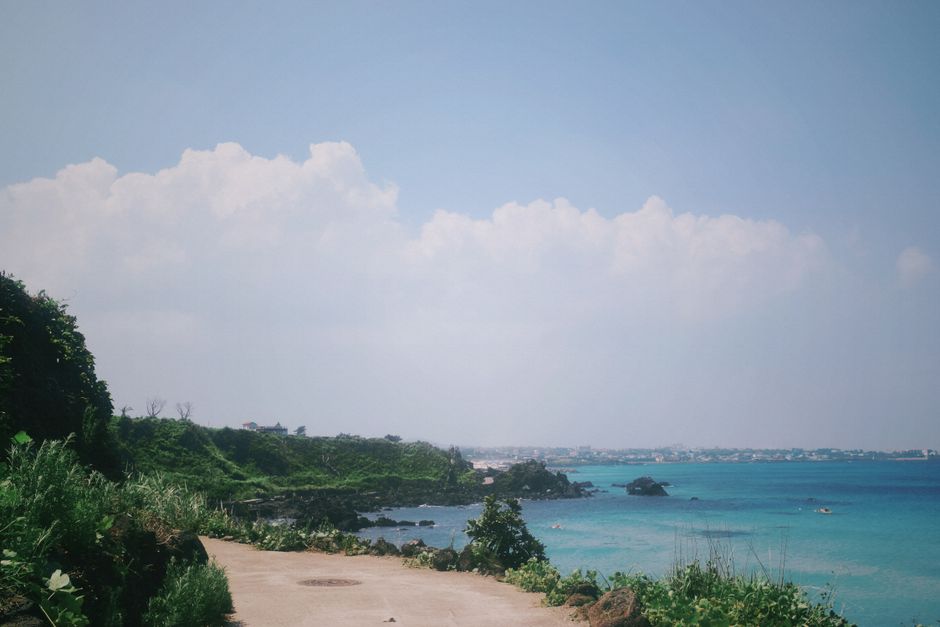
The Handam Coastal Walk runs along the shoreline between Aewol Port (애월항) and Handam Beach (한담해변), a stretch of black volcanic rock interspersed with tide pools and small sandy patches. The path is paved with either wooden boardwalk or smooth concrete, with railings on the seaward side and minimal elevation change, making it accessible for all fitness levels. The scenery is representative of Jeju's volcanic coastline: jagged basalt, turquoise shallows, and views across to smaller islets offshore. The walk is popular with Korean visitors but less crowded than the Olle Trail segments near Seogwipo, and it sees fewer foreign tourists because it is not near any major bus stops.
Because the walk itself is short, it functions as a half-morning or late-afternoon activity rather than a full-day destination. Most itineraries pair it with a cluster of south- and west-coast sights—Jusangjeolli Cliff, Yakcheonsa Temple (약천사), Cheonjiyeon or Jeongbang waterfalls, and the Seogwipo waterfront—so that you complete a loop by car or taxi in one day, or split it across two days if you want a slower pace with beach time or a hike up Songaksan (송악산). If you are relying on public buses, the Handam walk becomes harder to slot in efficiently, because the nearest intercity bus stops are in Aewol-ri, roughly one to two kilometres away, and services run every 40 to 90 minutes depending on the route. A rental car, scooter, or hired taxi for a half-day tour gives you the flexibility to move between sights without losing two hours to waiting.
How to get to the Handam Coastal Walk
The walk has two main access points: the northern trailhead near Aewol Port and the southern end near Handam Beach. Most visitors park at the Handam Beach car park (한담해변 주차장), which is free and has space for roughly 50 cars; from there, you walk north along the path. If approaching from Jeju City by car, the drive is about 20 to 25 minutes via Route 1132 heading west, then south along the coastal road. Navigation apps Naver Map and KakaoMap both show the car park and the walking path; Google Maps shows the location but does not provide turn-by-turn driving directions in Korea, so you will need one of the Korean apps.
By public bus, take route 202 or 282 from Jeju Intercity Bus Terminal (제주시외버스터미널) toward Aewol; the journey takes about 40 to 50 minutes and costs roughly 1,500-2,000 KRW with a T-money card (티머니). Buses run every 40 to 90 minutes depending on the day and season—confirm the live schedule in Naver Map or KakaoMap rather than relying on printed timetables. Alight at Aewol-ri (애월리) or Aewol Port (애월항) stops, then walk about one to two kilometres south along the coast road to reach the northern trailhead. The walk from the bus stop to the trail adds 15 to 25 minutes and is not particularly scenic, which is why most independent travellers opt for a car.
Taxis from Jeju City to Handam Beach cost roughly 25,000 to 35,000 KRW one way, metered, depending on traffic. If you plan to visit multiple sights in one day, negotiate a half-day hire with the driver (around 80,000 to 120,000 KRW for four hours) or use the Kakao T app to book each leg separately. Tipping is not customary in Korea; the metered or agreed fare is the final amount.

Two-day itinerary combining Handam with south-coast highlights
Day one focuses on the Handam walk and the western half of the south coast. Start early in Jeju City or your accommodation in the Aewol area, and drive or taxi to Handam Beach by 9:00 or 9:30. Complete the coastal walk at a relaxed pace, allowing 45 minutes to one hour with photo stops. Afterwards, drive five minutes south to Jusangjeolli Cliff (주상절리대), a dramatic formation of vertical basalt columns that drop into the sea. Entry is around 2,000 KRW per adult; the viewing platforms and short loop path take about 30 to 40 minutes. From there, continue east to Yakcheonsa Temple (약천사), a large Buddhist temple complex on the hillside above the coast, about 10 minutes by car. Entry is free; the main hall and grounds can be explored in 20 to 30 minutes. If you want lunch, drive to Seogwipo city centre, about 15 minutes east, and eat near Seogwipo Olle Market (서귀포매일올레시장), a covered market with cooked-food stalls serving kimbap (김밥), seafood noodles, and grilled fish. Most dishes cost 6,000 to 12,000 KRW.
In the afternoon, visit Cheonjiyeon Waterfall (천지연폭포), a short walk from the Seogwipo waterfront. The entry fee is roughly 2,000 KRW; the paved path to the falls and back takes about 30 to 40 minutes. If you have time and energy, walk along Seogwipo's harbour promenade or visit Jeongbang Waterfall (정방폭포), one of the few waterfalls in Asia that falls directly into the sea, about five minutes by car from Cheonjiyeon. Entry is around 2,000 KRW, and the descent to the beach viewing area involves stairs.
Day two can loop back west or focus on the eastern part of Seogwipo. Options include Seongeup Folk Village (성읍민속마을), a preserved traditional village about 30 minutes northeast of Seogwipo with stone walls, thatched roofs and free entry; Seopjikoji (섭지코지), a scenic coastal headland near Seongsan with walking paths and ocean views; or Seongsan Ilchulbong (성산일출봉), a UNESCO-listed tuff cone with a steep but short hike to the crater rim. Each of these sights takes about one to two hours, so you can combine two or three depending on your pace and return to Jeju City by evening.
Best time of day and season to walk Handam
The Handam Coastal Walk is exposed, with minimal tree cover and no shade structures, so timing matters for comfort and photos. Early morning, between 8:00 and 10:00, offers cooler temperatures and softer light; late afternoon, from 16:00 to 18:00, gives warm golden-hour light and fewer visitors. Midday sun in summer can be harsh, and the concrete and wooden boardwalk surfaces radiate heat. If you visit in July or August, walk early or late, and bring sunscreen, a wide-brimmed hat, and water—there are no shops, vending machines or cafés directly on the path.
Seasonally, April to May and September to October are the most comfortable months: daytime highs around 18 to 24°C, lower humidity, and minimal rain outside the occasional shower. June to August is Jeju's wet season, with heavy rain, high humidity, and the risk of typhoons, especially in late August and early September; paths can be slippery, and wind gusts near the cliff edge can be strong enough to be unpleasant. November to March brings cooler, windier weather; temperatures range from 5 to 15°C, and the coastal wind can make it feel colder. The path remains open year-round, but winter visits require a windbreaker or light jacket, and some visitors find the experience less enjoyable without the greenery and flower blooms of spring.
Jeju is busiest during Korean public holidays—Lunar New Year (late January or early February), Chuseok (mid-September or early October), and the first week of May—when domestic tourists fill hotels and rental cars. If you visit during these windows, book accommodation and cars well in advance, and expect longer waits at popular sights.

What to bring and practical tips for the walk
The path is fully paved and has no steep gradients, so normal walking shoes or trainers are sufficient; you do not need hiking boots. Because the surface is smooth concrete or treated wood, it can be slippery when wet—avoid the walk during or immediately after heavy rain. Handrails line the seaward side, but there are gaps, and sections come close to cliff edges with a drop of several metres to rocks and water below. Parents with young children should supervise closely, and the path is not suitable for very young children who are unsteady on their feet.
Bring sunscreen, a hat, and a light windbreaker or long-sleeved layer, even in warm months, because the coastal wind is persistent. There is no drinking water, rubbish bins, or public toilets directly on the 1.2-kilometre path; the nearest facilities are at the Handam Beach car park at the southern end and at small cafés in Aewol village to the north. Plan to use the toilet and fill a water bottle before you start.
Photography is the main activity, so a phone or camera is useful. The best vantage points are along the middle section, where the wooden boardwalk curves around rock outcrops and tide pools. Low tide exposes more of the rock formations and pools, while high tide brings waves closer to the path; check tide times in advance if you want a specific effect, though the walk is scenic at any tide level.
Mobile data coverage is good along the entire path, so you can use Naver Map or KakaoMap for navigation and photos upload in real time. Jeju has widespread free Wi-Fi at major tourist sites, but not along this path; if you do not have a Korean SIM or eSIM, download offline maps in advance.
Where to eat before or after the walk
The immediate area around Handam Beach and the coastal walk has very limited dining options. The closest cluster of cafés and restaurants is in Aewol-ri (애월리), about one to two kilometres north of the walk's northern trailhead, along the coast road. Aewol has become known among Korean visitors for its seaside cafés—many are large, modern spaces with ocean views, serving coffee, cakes, sandwiches and light brunch dishes. Prices are roughly 6,000 to 9,000 KRW for coffee and 12,000 to 18,000 KRW for brunch plates. These cafés are designed for lingering rather than quick service, so factor in 45 minutes to an hour if you stop. Specific well-known names include Aewol Monsant (애월몽상) and Bomnal Café (봄날카페), both real, longstanding businesses visible on Naver Map.
For a more substantial Korean meal, drive 15 minutes east to Seogwipo city centre. Seogwipo Olle Market (서귀포매일올레시장) is a covered traditional market with dozens of small stalls and simple restaurants serving grilled mackerel (고등어구이), seafood kalguksu (칼국수, knife-cut noodle soup), and abalone porridge (전복죽). Most dishes cost 8,000 to 15,000 KRW. The market operates daily from around 8:00 to 20:00, with some stalls closing earlier; it is busiest at lunchtime. Payment is cash or card, and staff generally do not speak English, but pointing at dishes or showing a photo on your phone works well.
Jeju black pork (흑돼지) is the island's signature dish, and Seogwipo has many barbecue restaurants specialising in it. A typical black-pork set for two costs 35,000 to 50,000 KRW and includes several cuts grilled at your table, with side dishes (banchan, 반찬) and lettuce wraps. Restaurants near Seogwipo's city hall and along the main streets west of the market are reliable; Naver Map shows user reviews and photos. Tipping is not customary, and service is included in the menu price.

Transport and car rental considerations
Jeju Island's public bus network connects Jeju City, Seogwipo, and the major towns, but frequency is low outside peak commuter hours, and many coastal sights—including Handam—require a one- to two-kilometre walk from the nearest stop. If you plan to visit more than two or three attractions per day, renting a car makes the itinerary far easier. Rental companies cluster around Jeju International Airport (제주국제공항); major firms include Lotte, AJ, SK and Jeju Rent-a-Car. A compact car costs roughly 50,000 to 80,000 KRW per day in low season and 80,000 to 120,000 KRW in peak summer and holiday periods. You need an International Driving Permit (IDP) if your home licence is not in Korean; check the rental company's requirements when booking.
Driving in Jeju is straightforward: roads are well maintained, signage includes English on major routes, and traffic is lighter than Seoul or Busan. Parking is free at most tourist sights, including Handam Beach, Jusangjeolli, and the waterfalls. Petrol stations accept cash and most Korean credit cards; international cards work at larger stations, but carrying some cash is useful for smaller rural pumps. Naver Map and KakaoMap both provide turn-by-turn voice navigation in English; Google Maps shows locations but not driving directions.
If you do not want to drive, the alternative is a combination of intercity buses for the main legs (Jeju City to Seogwipo, roughly 1,500-2,500 KRW and 60 to 90 minutes) and taxis for short hops between sights. Taxis are metered, starting around 3,500 to 4,000 KRW, and a 10-kilometre ride costs roughly 12,000 to 18,000 KRW. The Kakao T app works across Jeju and shows the estimated fare before you book; drivers generally do not speak English, so have your destination written in Korean or ready to show on a map. For a day of sightseeing, negotiating a half-day or full-day hire (80,000 to 180,000 KRW depending on hours and distance) can be more convenient and cost-effective than multiple short trips.

Sample two-day Handam Coastal Walk and south-coast itinerary
| Time | Activity | Location | Notes |
|---|---|---|---|
| Day 1: 09:00 | Handam Coastal Walk | Handam Beach (한담해변) | 1.2 km, 45-60 min; free entry; bring sun protection |
| 10:30 | Jusangjeolli Cliff | Jungmun area (중문) | Basalt columns; ~2,000 KRW entry; 30-40 min |
| 12:00 | Lunch | Seogwipo Olle Market (서귀포매일올레시장) | Seafood noodles, grilled fish; 8,000-15,000 KRW per dish |
| 14:00 | Cheonjiyeon Waterfall | Seogwipo (서귀포) | ~2,000 KRW entry; 30-40 min walk; paved path |
| Day 2: 09:30 | Seongeup Folk Village | Seongeup-ri (성읍리) | Traditional village; free entry; 60-90 min |
| 12:00 | Seongsan Ilchulbong | Seongsan (성산) | UNESCO tuff cone; entry ~5,000 KRW; 30-40 min hike to rim |
Practical tips
Frequently asked questions
Before you go
The Handam Coastal Walk is a short, accessible introduction to Jeju's volcanic shoreline, best experienced as one component of a south- or west-coast day rather than a standalone destination. If you have a rental car or hire a taxi for a half-day tour, you can comfortably pair the walk with Jusangjeolli Cliff, a waterfall, and a meal in Seogwipo, creating a varied day that balances coastal scenery, cultural sights, and local food. Visitors relying on public buses will need to budget extra time for connections and walking from stops, or accept a slower pace and fewer sights. Go early or late in the day to avoid midday heat, bring sun and wind protection, and confirm onward transport or parking before you set out—Jeju's appeal is in its coastline and open spaces, but those same qualities mean services are spread out and advance planning pays off.
- How Long to Stay in Jeju Island: 3, 5 or 7 Days Explained
- Jeju Island Day Trip from Busan: Why You Shouldn't (+ Better Options)
- Jeju Island Trip Cost from Philippines (2026 Budget Guide)
- Where to Stay in Seoul: 5 Best Neighbourhoods for First Visits
- What to Wear in Korea in May: Layer-by-Layer Packing Guide


Comments
Post a Comment